
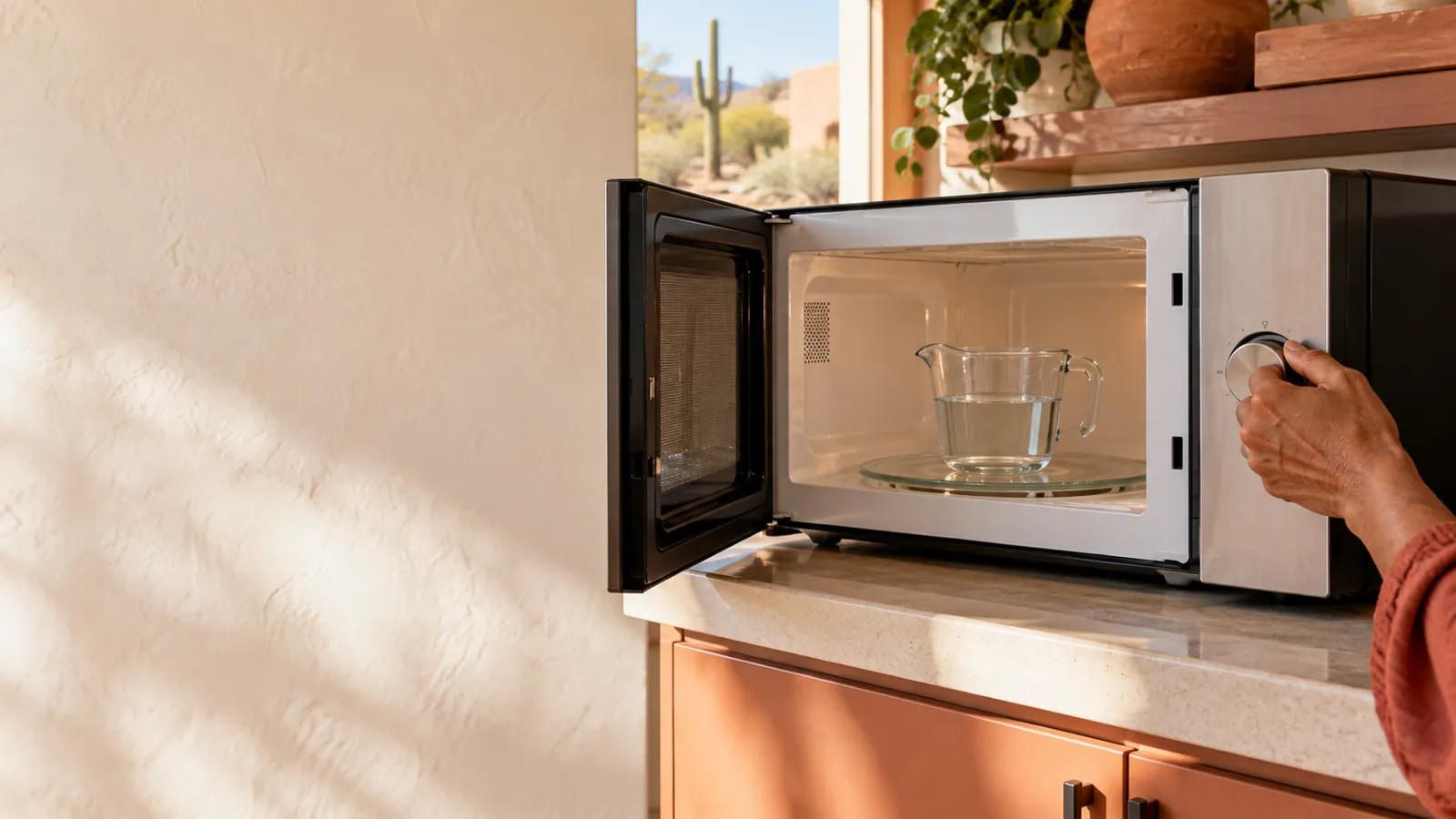
When a microwave isn’t heating, it’s one of five things, and two of them aren’t problems at all. Go down the list in order and stop at the first one that matches what you’re seeing.
Pay the most attention to the last step. When we say never open the case, we mean it, and it’s not a lawyer talking. The capacitor in a microwave stores enough charge to kill you, even after it’s been unplugged for days.
Take those first two seriously, because they’re behind more calls than any real failure. A microwave that heats water fine but leaves the middle of a lasagna cold is working the way it’s built to work. Microwaves heat unevenly, and a thick dish straight out of the fridge needs to sit a bit after cooking, not a service call. And a microwave sharing a kitchen circuit with a kettle can lose enough power to run its fan and light but never fire the magnetron. From the outside, that looks exactly like a dead oven.
After those, we see the same thing over and over. Door interlock switches fail more than any other part in a microwave. They’re mechanical, they work every time you open and close the door, and the manufacturer builds them so the oven shuts off safe when one fails. So when one goes, the oven does everything except heat. That’s the safety design doing its job.
Stop The high-voltage side is different. That’s where you stop poking around. A microwave capacitor stores enough charge to kill you, and it holds that charge after the unit’s unplugged, for days, not seconds. There’s no safe way to test it without the right tool and the training to use it. We’re not saying this to cover ourselves. It’s why the fifth step says stop.