
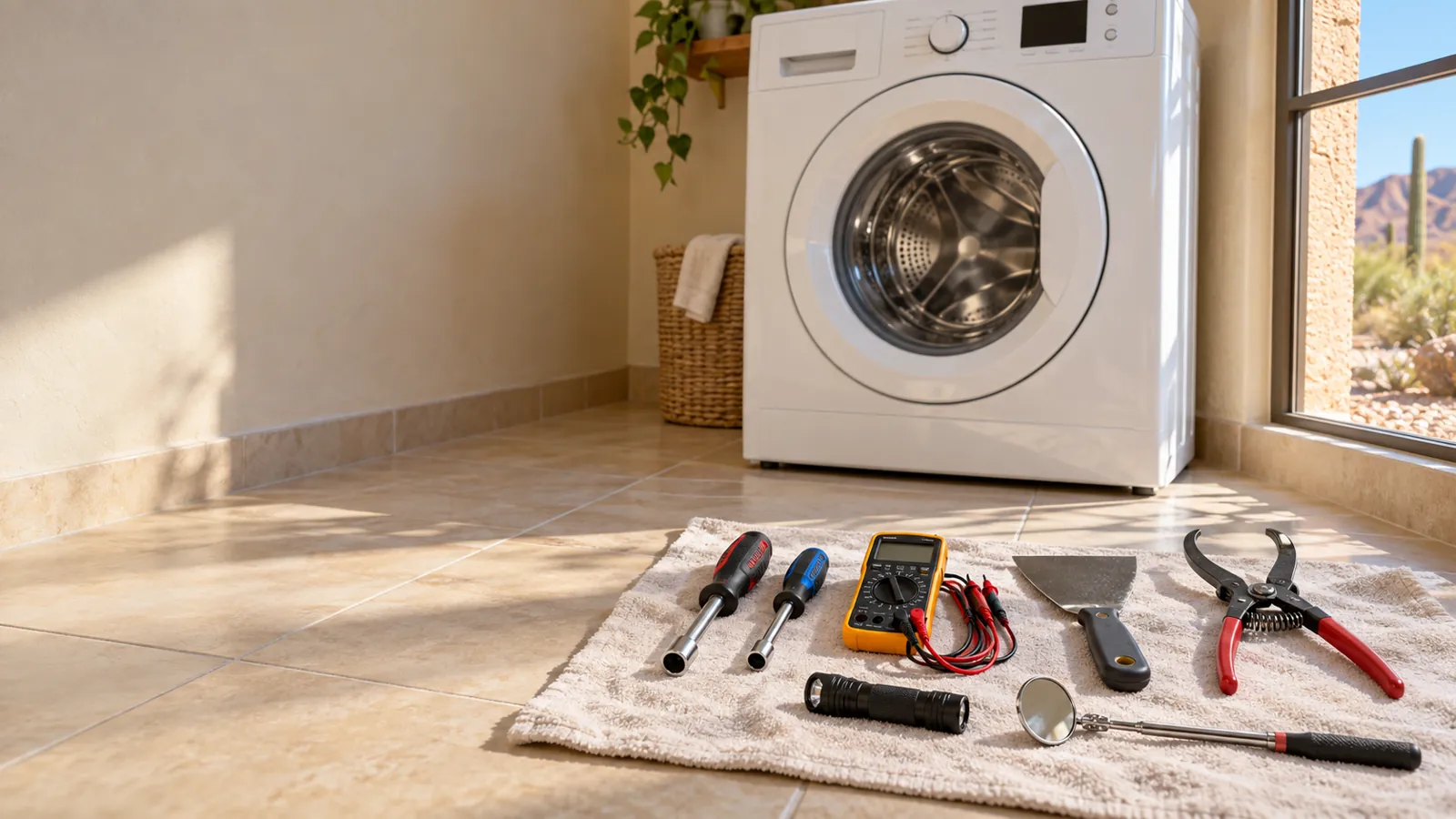
Washer repair tools are worth buying if you plan to take on the four or five problems a homeowner can really handle. Past those, you need special tools fast, and the math stops working.
The short list that covers most of it
A nut driver set, especially 1/4 and 5/16. Almost every panel screw on a washing machine is one of those two sizes. Use a driver instead of pliers, and the panel goes back on without chewed-up screw heads.
A multimeter. This tool lets you test a part instead of guessing. A door lock, a heating element, the water temperature sensor (called a thermistor) and a motor winding will all tell you whether they’ve failed in about thirty seconds, if you can test them. Without a meter, you’re swapping parts and hoping, and on a washing machine that gets expensive fast.
A putty knife or a spring clamp tool for door boots (the rubber ring around the door opening) and hose clamps on a front loader. A screwdriver will do the job, but it’ll also nick the boot, and then your repair has turned into a leak.
A flashlight and a mirror. Most of what you need to see on a washing machine is hidden behind something else.
What those tools let you fix
Drain pumps, door locks, water valves (where the water comes in), hoses, replacing the drain hose, and tracking down the problem on nearly everything else. That covers a good share of common washing machine problems, and all of them are doable if you take it step by step.
The pump in particular is worth doing yourself. It fails more often than any other part on a washing machine, you can usually get to it from the front or the bottom, and it doesn’t cost much.
What those tools won’t fix
Drum bearings. On a front loader, that means splitting the outer tub apart, which takes a puller, a press or a lot of making do. By the time you’re finished, the labor would have cost about what a mid-range new washer does. This is the repair where we most often tell people not to bother, and we tell them before we charge anything to look.
Transmission and gearbox work on a top loader is the same story.
How Arizona changes what breaks
Arizona Water here runs 16 to 28 grains per gallon, which is very hard water. The national range is 7 to 10. So scale builds up in the water valve and around the heater a lot faster here.
A valve that’s only opening part of the way gives you long fill times and cold washes. To anybody without a multimeter, that looks exactly like a bad pressure switch.
That’s a good example of why the meter is worth having. The symptom points one way, the meter points somewhere else, and testing costs you nothing.
Doing the math
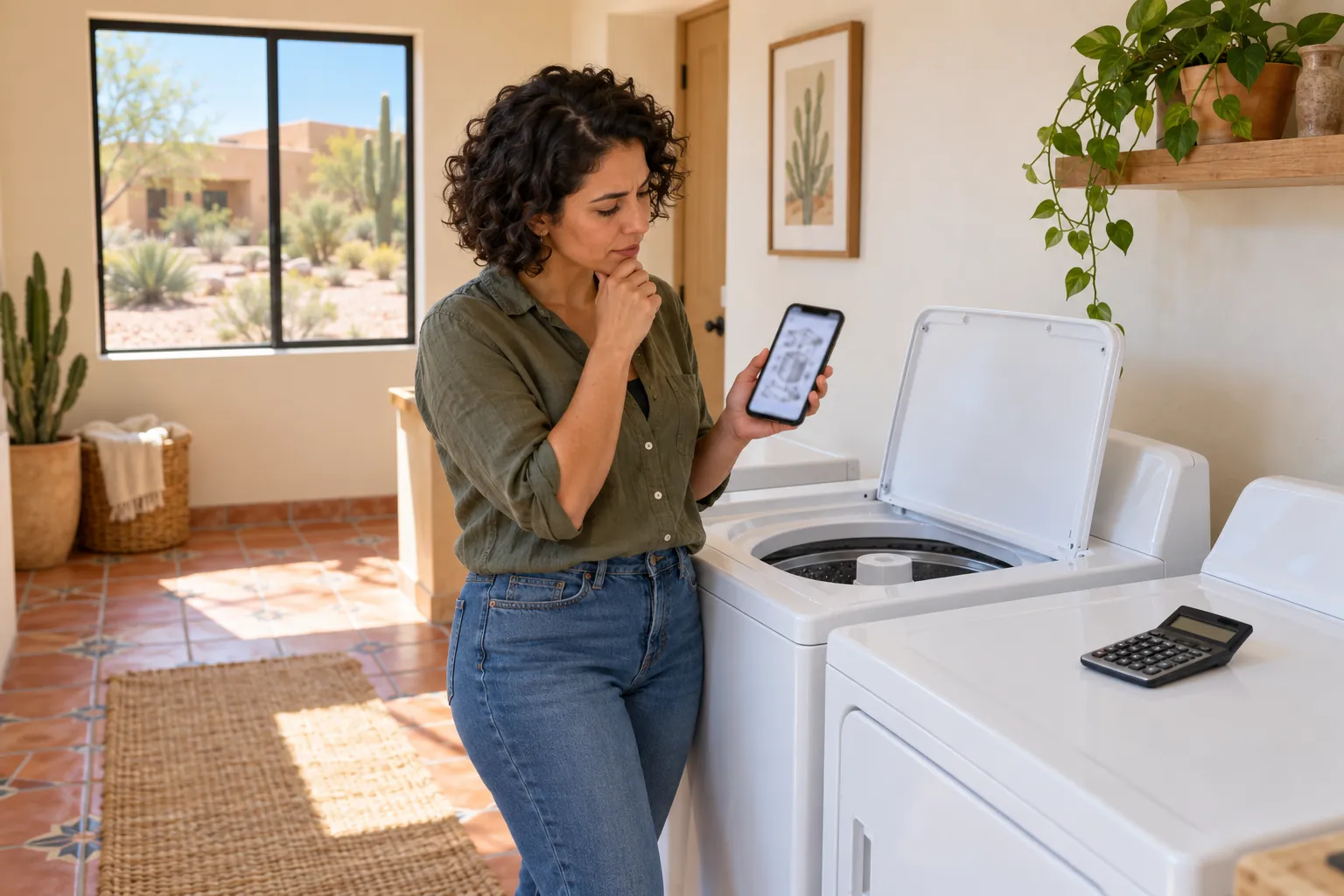
If you already own the tools, a pump or a door lock is worth doing yourself. If you’d be buying tools just for this one repair, add their cost to your estimate before you compare it to a flat-rate quote. And remember that if you guess wrong, you’ll be buying a second part too.
We quote a flat rate before we start, nobody here works on commission, and if the machine isn’t worth fixing, we’ll tell you.
Before you buy any parts
Order by model number, not by description. Washing machine model numbers change from one production run to the next, and a part that looks identical in a photo often isn’t. The model plate is usually inside the door opening, on the frame behind the door, or on the back panel near the top.
Buy from a supplier that lists which model numbers a part fits, not one that only lists the part. It costs a little more, but it saves you the second order. That second order is what turns a Saturday repair into a week without a washing machine.
Do it in this order
Tip Symptom first, test second, parts third.
People flip that around all the time. They read about a symptom online, order whatever part the forum post mentioned, put it in, and nothing changes. The meter costs less than one wrong part, and it takes the guessing out of it.
If you get through all the checks and the meter points at something you can’t get to, that’s still a win. You know what’s wrong, you can explain it clearly on the phone, and the visit is shorter and cheaper because of it.