
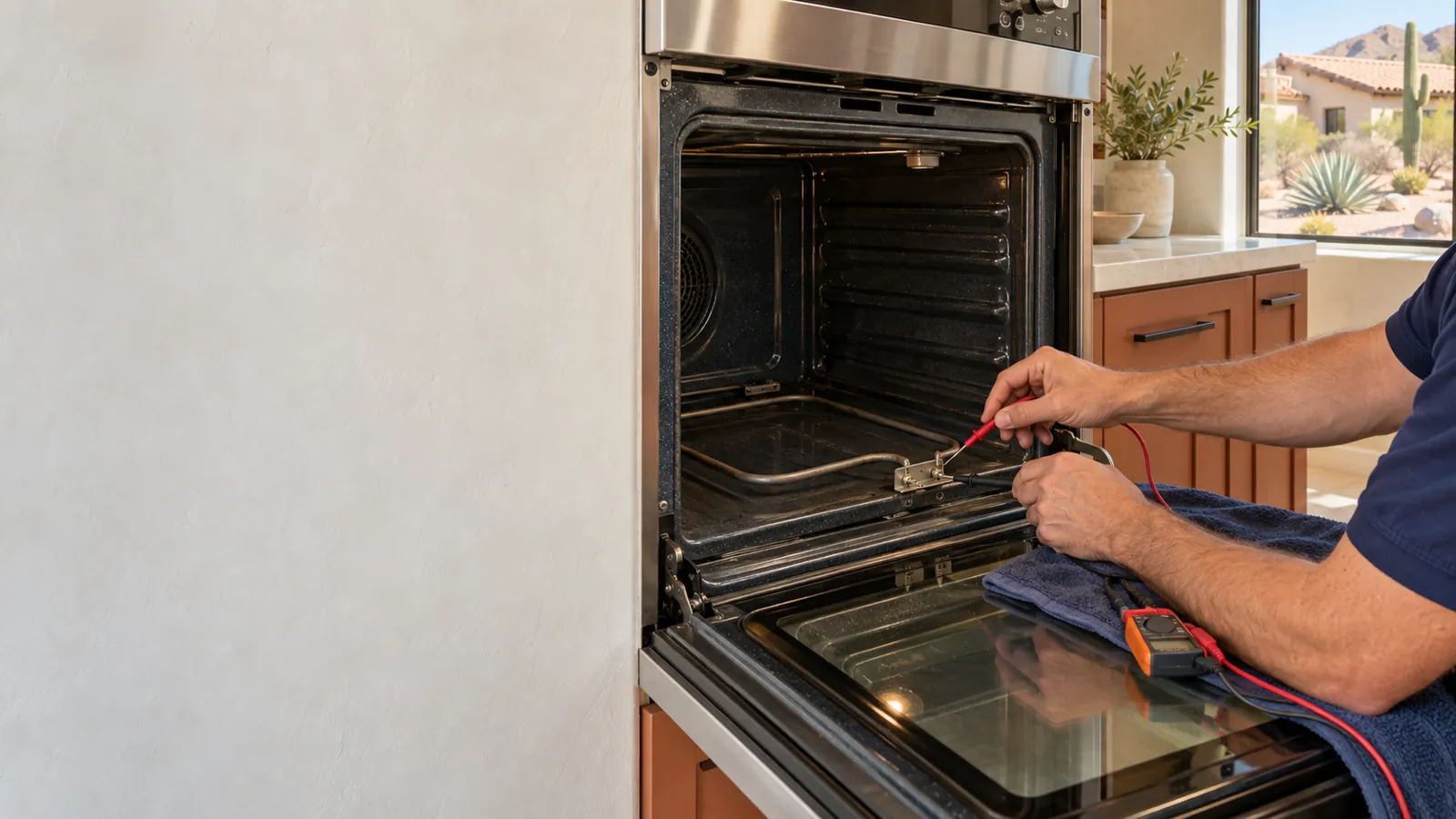
Most oven repair calls come down to about five problems. The good news is the symptom usually tells you which one it is before anybody takes anything apart.
Not heating at all
On an electric oven, look at the bake element while the oven is cold. A burned-out element often has a break you can see, or a spot that’s bubbled up. If it looks fine, the problem is more likely the thermal fuse (a safety cutoff that trips when things get too hot) or the controls.
On gas, it’s the igniter far more often than the valve. A gas oven igniter has to pull enough power to open the safety valve, and it gets weaker with age. So you get a long preheat, then a really long preheat, then nothing. If your gas oven has been getting slower for months, that’s the igniter on its way out.
Heating unevenly
Check the door seal first. A seal with gaps makes one side of everything brown faster than the other. People go after the element for months before anyone looks at the gasket.
Next, check the convection fan if your oven has one, and the rack position. Rack position sounds too simple to matter, but it isn’t. Most uneven-baking complaints on an oven with nothing wrong with it come down to a rack sitting too close to the element.
Running hot or cold
Put a thermometer on the middle shelf, run a full preheat, and wait ten more minutes. If it’s off by 25 degrees or more, it’s worth fixing, and most ovens have an offset setting in the control menu to adjust it. If it’s off by 50 or more, the temperature sensor is the more likely problem, and that’s a cheap part.
The door won’t close straight
Hinges sag over the years, especially on heavy doors. A crooked door lets heat out, and sooner or later it wrecks the seal too. Hinges can be replaced, and it’s not a big job.
Self-clean killed it
This one surprises people. A self-clean cycle gets the inside of the oven extremely hot. On older ovens, that heat is what finally kills a worn-out thermal fuse or control board. If your oven died during or right after self-clean, that’s what happened. It wasn’t a coincidence. It’s also why we suggest cleaning by hand on any oven over about ten years old.
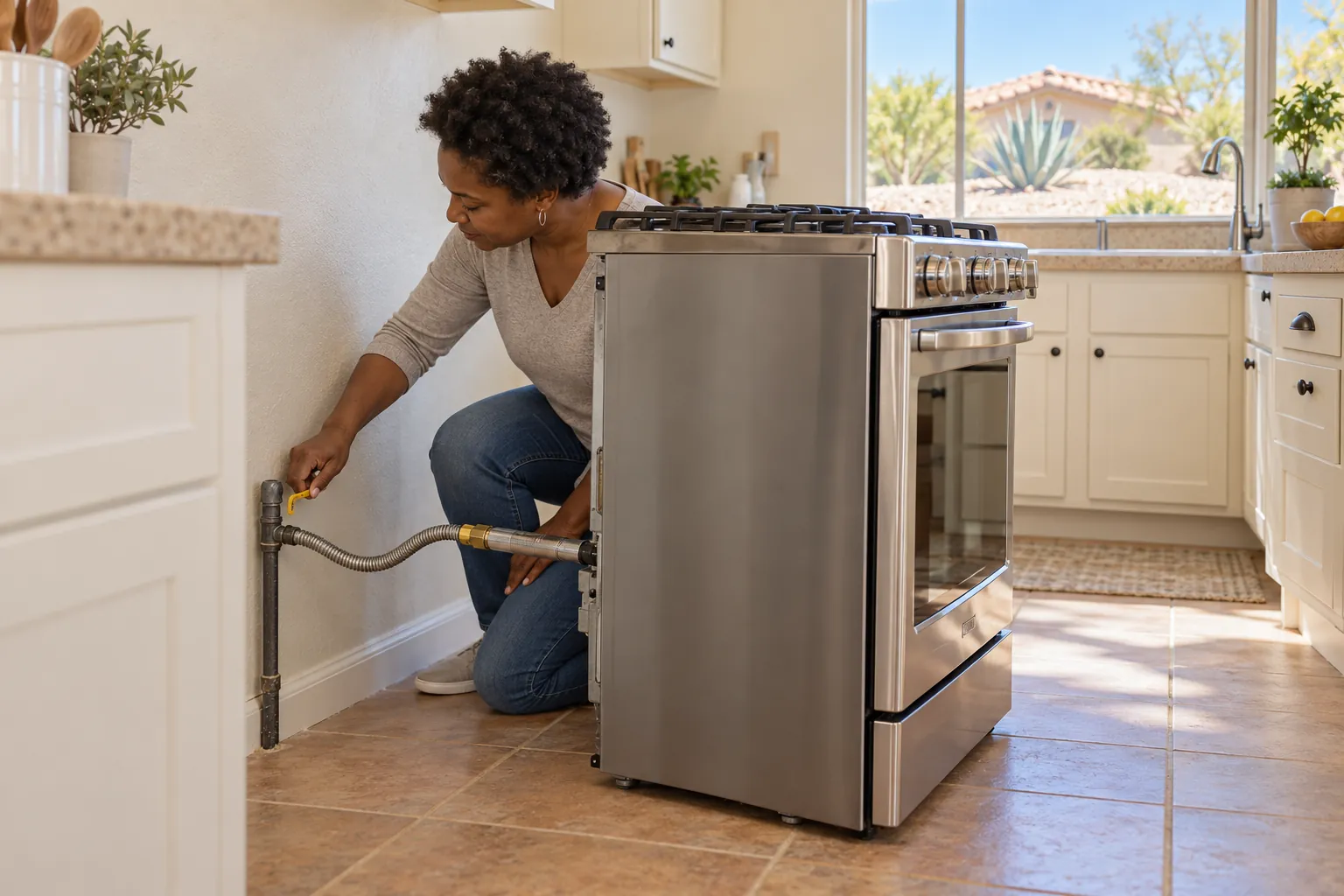
The one that means stop
Stop You smell gas. Get everyone out, call the gas company first, and then call us. Don’t test the igniter, don’t run the oven, and don’t go looking for the leak. There’s no safe amount of poking around on this one.
Of everything in this article, it’s the only problem where we tell you to do nothing yourself.
What we’d check before calling
With the oven cold, look at the element. Close the door on a dollar bill and make sure the seal drags when you pull it. Put a thermometer on the middle shelf and see what it reads compared to the dial. Those three checks take fifteen minutes, and they tell you more than any amount of guessing from the symptoms.
What breaks most, in order
Across the ovens we work on, the order stays the same. Igniter on gas, bake element on electric, then the temperature sensor, the door seal, and the hinges. Control boards are lower on that list than people think. They also get replaced for no reason more than any other part. A board is easy to blame when the real problem is a sensor reading wrong.
That order matters for your wallet. An igniter, an element or a sensor is an inexpensive part and about an hour of labor. A board costs several times that. A tech who goes straight for the board without testing the sensor first is guessing with your money.
Why cleaning is a repair issue
Spills that bake on turn to carbon, and that carbon coats the temperature sensor. A sensor covered in burnt gunk reads low. So the oven runs hotter to make up for it, and more spills burn on. It feeds itself, and it’s the easiest oven problem to prevent.
Tip Clean the inside of the oven by hand once a month. On any oven over ten years old, we’d skip the self-clean cycle completely. The heat it puts out is what finishes off worn parts, and a bucket of warm water does the same job without the risk.