
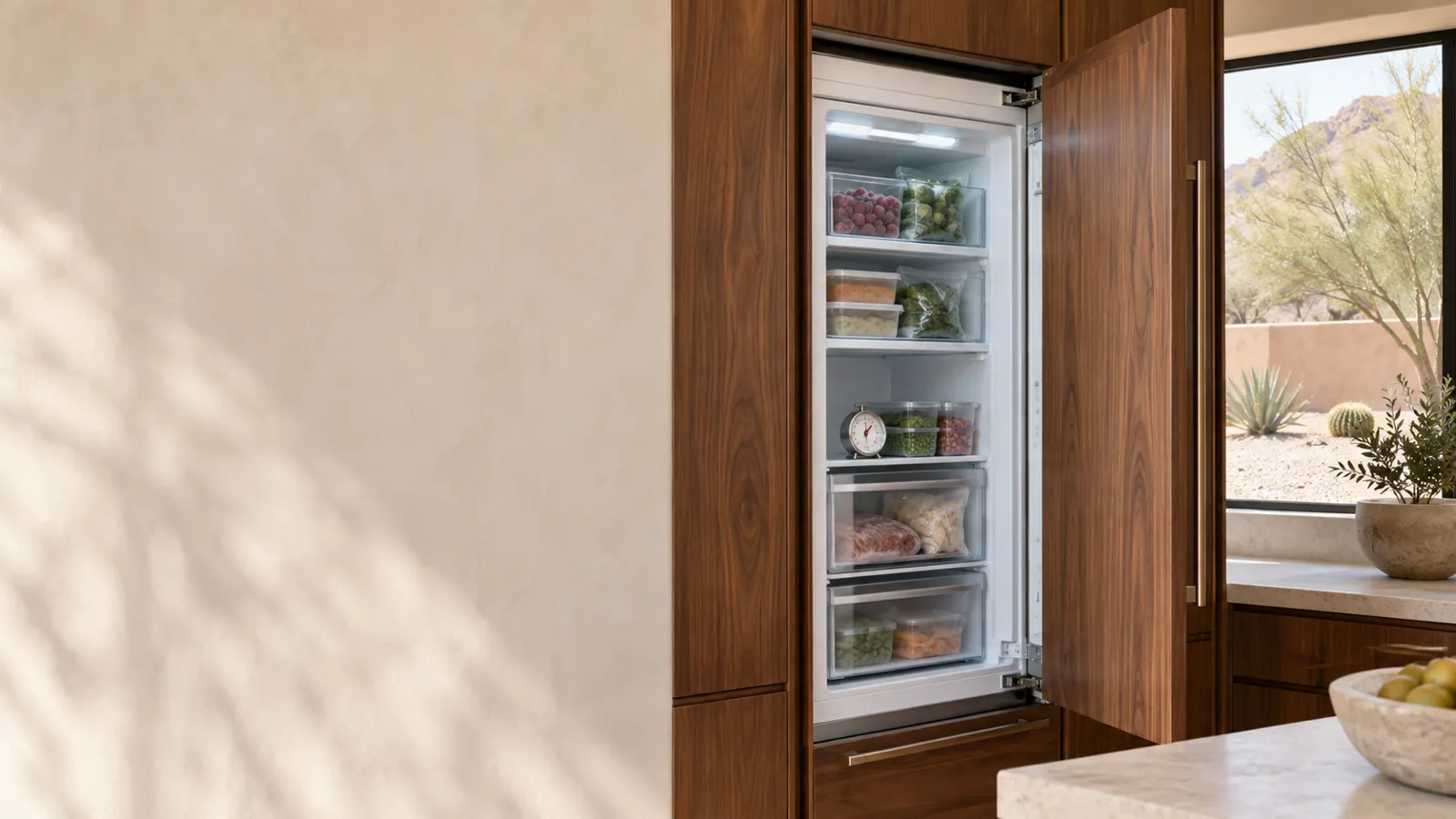
Sub-Zero freezer temperature fluctuations are usually an airflow problem long before they’re a refrigeration problem. On a built-in, that matters more than it does on a freestanding unit.
Why built-ins drift before they fail
A freestanding freezer gets rid of heat off an open coil on the back. A built-in has to pull air through a grille, run it across a condenser (the coils that shed the heat) packed into a cabinet, and push it back out, all inside a space made to look like cabinetry. When that airflow gets blocked, the unit doesn’t stop. It works harder, holds temperature less steadily, and the first thing you notice is the number moving around.
So on these, swinging temperatures come early and a dead freezer comes late. Catch it while it’s still drifting, and you’re looking at a cleaning instead of a compressor.
Start with the condenser, every time
Find the grille. It’s on top on some models and at the bottom on others. Look at the coils behind it. If they’re fuzzy with dust, you’ve found your problem, and it’s a job for a vacuum and a brush, not a service call.
Arizona Here, do it every six months. Arizona heat leaves these units nothing in reserve, and a built-in boxed in by cabinets gets less air than the factory specs assume.
The door and the gasket
Close the door on a dollar bill and pull. On a built-in the door is heavy, and the gasket carries that weight thousands of times, so it flattens on the hinge side first. A gasket that lets warm, humid air in causes exactly the kind of swings people tell us about. It also explains frost showing up where it shouldn’t.
Check the hinges too. If the door hangs even a little crooked, it’ll seal at the top and leave a gap at the bottom.
Defrost cycles that run long
If the temperature climbs on a regular schedule instead of at random, suspect the defrost system. A heater, or the sensor that tells it when to shut off, that doesn’t cut out on time puts heat into the freezer on a schedule. You’ll see the pattern once you watch it over a whole day instead of checking one reading.
For this one, a service call is worth the money. Figuring it out right means watching the cycle, not guessing from the symptom.
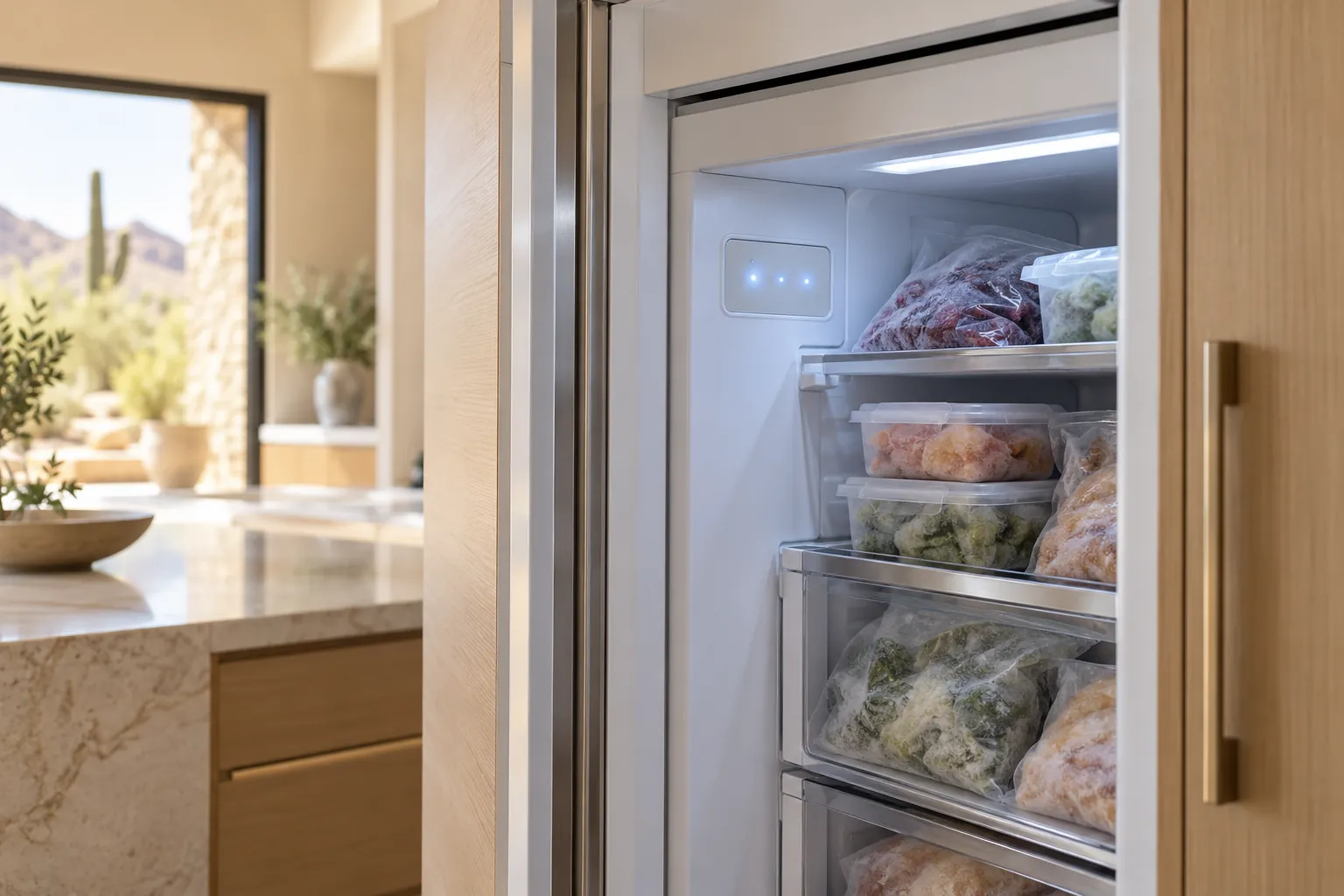
Sensors drift, and the alarm is right
Note If the alarm goes off while the food is still frozen solid, it’s not a false alarm. Frozen food holds its cold long after the air temperature has changed. The control is reading the air, and you’re looking at the food. Trust the control.
What it costs, and when it’s worth it
Figure $50 to $100 for the service call to find the problem and $150 to $600 for a typical repair with parts. We quote a flat rate before anyone starts. On a Sub-Zero, repair makes sense a lot longer than it does on a budget machine, because the rest of the unit is built to keep going for twenty years. A repair at year ten buys a lot of life. And replacing a built-in also means finding one that fits the cabinet opening.
We work on these across Pinal and Maricopa County, and nobody here works on commission. So if a repair to the sealed refrigerant system on a very old unit isn’t worth the money, we’ll tell you that.
What to have ready when you call
Have the model and serial number. They’re on a plate inside the door or behind the grille. Then describe the pattern, not a single reading. “It sits at zero most of the day and climbs to fifteen around the same time every evening” tells us a lot more than “it’s not cold enough.” It also points straight at defrost, not refrigerant.
Tip If you’ve got a thermometer in there, write down what it reads next to what the display says. If they don’t match, that points to a sensor, and it saves us a whole step in figuring out what’s wrong.
The other units in the same kitchen
Sub-Zero, Wolf and Cove are all Sub-Zero Group, so a kitchen with one usually has at least two. That’s handy. The parts come through the same supplier, and if we’re already there for the freezer, tell us about anything the range or dishwasher has been doing. A second look costs nothing while a tech is standing there, and it beats paying a separate trip fee later.